
Thursday, my work tenant wasn’t the only thing affected by the Microsoft 365 outage. My personal Outlook email was greatly affected too, and I couldn’t use Microsoft Copilot on my personal account. I use Copilot to help evaluate plans and catch up on tasks for my family, and that help wasn’t available.
Outlook.com Went Down – What Happened
Update pending (November 15, 2026): Microsoft’s post-incident review. Microsoft has shared a preliminary root cause, which is below. Microsoft says it will publish a final one within five business days. I’ll update this post when the final review is published.
The same global incident officially started Thursday, November 12, 2026, at 10:17 AM Central Time, although services started becoming unavailable before that time. Microsoft is tracking it as EX1550543 and MO1550821. It wasn’t only work accounts. Microsoft’s public status page also showed degradation for consumer services, including Outlook.com and OneDrive, and delivery to Outlook.com and Hotmail addresses was delayed.
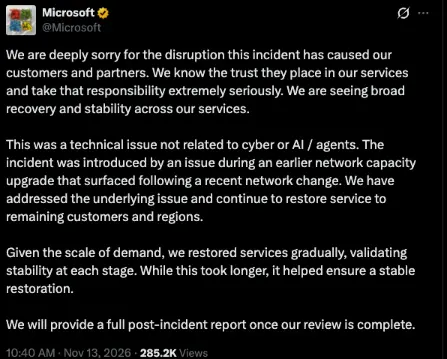
Microsoft closed both incidents late Friday night, November 13, and early Saturday morning posted that it had restored service to the remaining impacted customers and regions. Microsoft’s preliminary root cause is a failure in the systems that establish secure connections to the service. Traffic shifts during standard network maintenance and upgrades exposed a latent bug, and Microsoft said the incident “was introduced by an issue during an earlier network capacity upgrade that surfaced following a recent network change.” Microsoft again said there was no malicious activity, calling it “a technical issue not related to cyber or AI / agents.” On Friday, Microsoft also posted on X to apologize to customers and partners. Microsoft says its analysis is still ongoing, so I’ll wait for the post-incident review before saying anything stronger about the cause.
Your Personal Inbox Is More Than Email
It’s easy to think of a personal Outlook.com or Hotmail address as just email. That inbox is still how a lot of daily life gets done: appointments, school notes, travel confirmations, purchase receipts, and the password resets or one-time codes many sites send when you need to get back into an account. If that inbox is unavailable, those resets and codes are unavailable too.
This is not an argument for leaving Outlook.com. I use it too. It is an argument against making one inbox the only recovery option for every account you have. If the same address is the recovery path for your bank, your shopping accounts, and your family accounts, an outage like Thursday’s can keep you out of all of them at the same time.
I noticed the same thing with Microsoft Copilot. I have come to rely on it for family plans and tasks, and when it was down, I didn’t have another way to get that help.
What I Would Set Up
After Thursday, this is what I would do:
- Add a second recovery email and a phone number on the accounts that matter, then test that a recovery text or alternate email actually arrives.
- Keep a way to reach your family that doesn’t depend on Outlook.com, such as a phone call, a text, or a family group chat.
- Don’t start resetting passwords, removing accounts from Outlook, or reinstalling apps during a known outage. That will not fix a problem on Microsoft’s side.
- Check Microsoft’s public status page at status.cloud.microsoft and expect more phishing attempts. Official status updates will not ask you to sign in from an unexpected email or text.
- Keep an offline or alternate copy of mail you can’t afford to lose and be ready to resend anything time-sensitive once service returns. Expect delayed mail to arrive for a while after recovery and be careful with any message in that backlog that asks you to “verify” or “reset” something.
Final Thoughts
I do not believe the lesson is to abandon Microsoft. The lesson is the same one I wrote about on the business side: know what depends on that inbox and have another way to get a message through. If you run or support a Microsoft 365 tenant, that post is here: What the Microsoft 365 Outage Taught Us About Running a Company.
Let me know what you think!
Learn more:
